As I was watching it I immediately thought of Clay from Robot Stories. The plot lines are crazy similar: human man in love with robot female. But the key difference is the race factor - one film features a racially diverse cast whereas the other is predominately white (classic Hollywood...). It's interesting then to think about the actual, significant differences race makes in each story. Why choose an Asian male versus a white one? What merit does a certain race bring to a film? Or does it only matter because of the lack of representation for minority groups? So many questions!

Saturday, February 20, 2016
Her
A friend of mine recently sent me the link to the trailer of Her -
As I was watching it I immediately thought of Clay from Robot Stories. The plot lines are crazy similar: human man in love with robot female. But the key difference is the race factor - one film features a racially diverse cast whereas the other is predominately white (classic Hollywood...). It's interesting then to think about the actual, significant differences race makes in each story. Why choose an Asian male versus a white one? What merit does a certain race bring to a film? Or does it only matter because of the lack of representation for minority groups? So many questions!
As I was watching it I immediately thought of Clay from Robot Stories. The plot lines are crazy similar: human man in love with robot female. But the key difference is the race factor - one film features a racially diverse cast whereas the other is predominately white (classic Hollywood...). It's interesting then to think about the actual, significant differences race makes in each story. Why choose an Asian male versus a white one? What merit does a certain race bring to a film? Or does it only matter because of the lack of representation for minority groups? So many questions!

Thursday, February 18, 2016
DDR: Guide Away
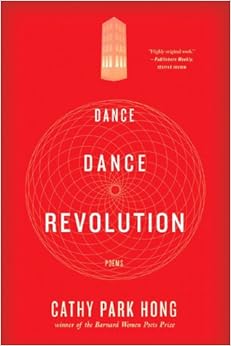 Picking up and reading through Cathy Park Hong's poetry collection titled Dance Dance Revolution has been nothing short of puzzling, exciting, and new. Most of the poems are spoken by the Tour Guide - though her words are apparently edited at times by the Historian - in 'Desert Creole,' a language that is a bit of every language.
The poem 5. Atop the St. Petersburg Dome is one such example of the Tour Guide's typical style of speaking. But more importantly, the poem's re-telling of a bit of the Tour Guide's personal history made me think of her relationships with honesty and history.
As we know, the hotel guide is bald and wears wigs to cover her scalp (she even says she has "wig-rash") (34). Then when I read the lines "a game show lass / wit no appliance to show," which imply that there is no great goal or reason why the guide still gives her tours, I thought about how perhaps the reason she gives tours is because they lend her the opportunity to direct attention away from herself and her troubled background (34). Just like her wigs, giving tours could be a one of the Tour Guide's defense or coping mechanisms.
Monday, February 8, 2016
Hierarchy
Language, words, slang - they uncover more about us and society than we think. The way we communicate today as opposed to ten years ago can show us where we are now, what's important to us, and how things have changed.
When Anna spoke down about 'sub-80s,' and Henry asserted that "everyone [in the bar] is a quality person" because they were all 'plus-80,' their words betrayed the influence EI scores had on their language. Moreover, they perpetuated a sort of caste system that values people based on numbers versus actual personality (science fiction, anyone?).
In almost every work we've read or seen, a hierarchy has been at place. Sometimes on the basis of race, other times on the basis of class, and still other times on other foundations. The hierarchy in Snowpiercer, for instance, was one that existed due to the difference in carriages within the train, which translated to a difference in class. Snowpiercer's a great example of hierarchy too since the rungs on the ladder are so clearly laid out.
In terms of how hierarchy plays into our study of Asian-American science fiction, it's clear that hierarchies exist in our society in the forms of discrimination and prejudice against POC's and minority groups. Representation in films like Everything Before Us and Robot Stories is one method of breaking down such systems.
Friday, January 29, 2016
OSAFS: The Epigraphs
We, at the height, are ready to decline.
There is a tide in the affairs of men,
Which, taken at the flood, leads on to fortune;
Omitted, all the voyage of their life
Is bound in shallows and in miseries.
On such a full sea are we now afloat,
And we must take the current when it serves
Or lose our ventures.
- William Shakespeare, Julius Caesar
Man, I regret not paying more attention to the epigraphs while reading the novel. It was only towards the end of this epic did I realize how much influence both - but especially the first - have on the course of events and the feelings that evolve throughout OSAFS.
The Shakespeare epigraph not only mirrors the revolution that occurs in B-Mor, starting with Fan's departure, but also reveals the dangers of sitting so high, so hazardously on top of the world. I also see a relation to the theme/idea of perfection that is ever-present in the story, from the organized B-Mor society to the luxurious Charter villages.
I found the most noticeable connection between the actual content of OSAFS and the Shakespeare epigraph on pages 356-357, when the narrator says, in response to the seemingly unexplainable feeling of fear flowing through the settlement, "It's irrational, for sure, maybe even mad, but as our recent hopes for B-Mor have evolved, everything else has begun to seem precarious."
We, at the height, are ready to decline.
I loved what Christina said in class the other day as well, about how the second epigraph, lyrics from "Only the Young" by the band Journey, might be the consequence or answer to the first. That "Only the young can say / They're free to fly away." Certainly freedom is another key theme that Lee makes a point of, particularly in the final chapters as things in B-Mor become increasingly shaky and uncertain.
I wish we knew more about what happened after the last, ambiguous page of OSAFS. I'm curious about the citizens 'left behind' by Fan, and if Fan, young and free, can ensure the "generation wait[ing] for dawn."
Friday, January 22, 2016
OSAFS: Fan & Stereotypes
Throughout our discussion of OSAFS, we have covered topics spanning class, gender, violence, geopolitics, aquaponics (@ Terrence!), technology, and many more. Yet the question initially posed by Mr. Khactu remains: How is OSAFS an Asian-American [sci-fi] novel?
There are several different ways the novel plays with Asian-American themes: basing New China off of China, Asian first and last names, descriptions of people and appearances, Asian food, and so on. I loved the Seneca Circus scene, filled with references to Korean food that I know and love to eat. The food tents somewhat reminded me of Korean street carts:
There are several different ways the novel plays with Asian-American themes: basing New China off of China, Asian first and last names, descriptions of people and appearances, Asian food, and so on. I loved the Seneca Circus scene, filled with references to Korean food that I know and love to eat. The food tents somewhat reminded me of Korean street carts:
 |
| excited to move back to Seoul for this! |
Anyways. One way that I thought OSAFS could be seen as an Asian-American story was, well, Fan. Fan, our favorite tiny protagonist. If we imagine Fan's appearance to be that of a small Asian-American girl with dark hair, we should also consider the stereotypes of Asian-American girls and how Fan either performs or breaks them.
The main stereotype I want to write about is the one that deems Asian-American girls passive, submissive, and quiet. Now, I want to know what you guys think - does this or does this not sound like Fan? What's your initial reaction?
I have mixed opinions, but I imagine many readers would argue that that stereotype does not seem like Fan. After all, she takes action in the beginning of OSAFS by leaving B-Mor and pursuing a tremendous journey through the counties and into Charter villages, all (?) for love. The narrator(s) certainly seem to agree that Fan's departure from B-Mor was unbelievable. But as the story progresses, in both Fan's world and the narrator(s)'s, it becomes clear that the tellers of Fan's story are not so sure about Fan's agency: "The funny thing about the tale of Fan is that much of what happened to her happened to her" (263).
So is Fan passive or active? Or both? Is she the epitome of the stereotype or does she kick it down? And what, if anything, is Lee trying to say about Asian-American stereotypes of girls?
Again, I'm left with more questions than answers...
Thursday, January 14, 2016
OSAFS: Embellishment
While I was reading OSAFS last night, I couldn't help but notice a few things about the story. Particularly about the parts that describe Fan's driving. On pages 147 and 164 the narrator(s) say(s) (respectively):
Wait. That doesn't sound plausible at all.
Perhaps the narrator(s) wanted to create an epic tale of adventure that favors the unlikely Fan, and so embellished the story to give their heroine an extra boost. But what happens when the story becomes embellished and sensationalized to the point of dishonesty and falsification?
Across the novel, certain phrases and details like Fan's driving often make me stop and wonder. Like in my last blog post about OSAFS, I am still trying to determine the narrator's reliability. I'm not too sure we'll ever get the real, untouched truth, however, so I'm going to take things with a grain of salt.
"Despite the awful details, his telling must have helped her relax at the wheel, the way music can allow our instincts to take over the countless mechanical operations that you couldn't possibly orchestrate if you had to think through each one."
"Fan drove for another stretch, having no trouble."Okay. Maybe Fan is a naturally gifted and talented 17-18 year old, who, once sitting at the wheel for the very first time in her entire life, feels completely at home and realizes that she knows the gears and controls like the back of her hand...
Wait. That doesn't sound plausible at all.
Perhaps the narrator(s) wanted to create an epic tale of adventure that favors the unlikely Fan, and so embellished the story to give their heroine an extra boost. But what happens when the story becomes embellished and sensationalized to the point of dishonesty and falsification?
Across the novel, certain phrases and details like Fan's driving often make me stop and wonder. Like in my last blog post about OSAFS, I am still trying to determine the narrator's reliability. I'm not too sure we'll ever get the real, untouched truth, however, so I'm going to take things with a grain of salt.
Subscribe to:
Posts (Atom)